
More than 500 years ago, three small ships left the coast of Spain and sailed west into the vast Atlantic Ocean.
Their names would eventually become some of the most famous ships in history: the Niña, the Pinta, and the Santa María.
Leading the expedition was a sailor named Christopher Columbus. His goal wasn’t actually to discover a new continent. Columbus was searching for a new route to Asia.
Instead, his voyage would bring Europeans and the peoples of the Americas into sustained contact and help set in motion enormous changes on both sides of the Atlantic.
So, who was Christopher Columbus? Why did he make his famous voyage in 1492? And what really happened when he reached land?
Here’s a kid-friendly look at one of history’s most consequential voyages.
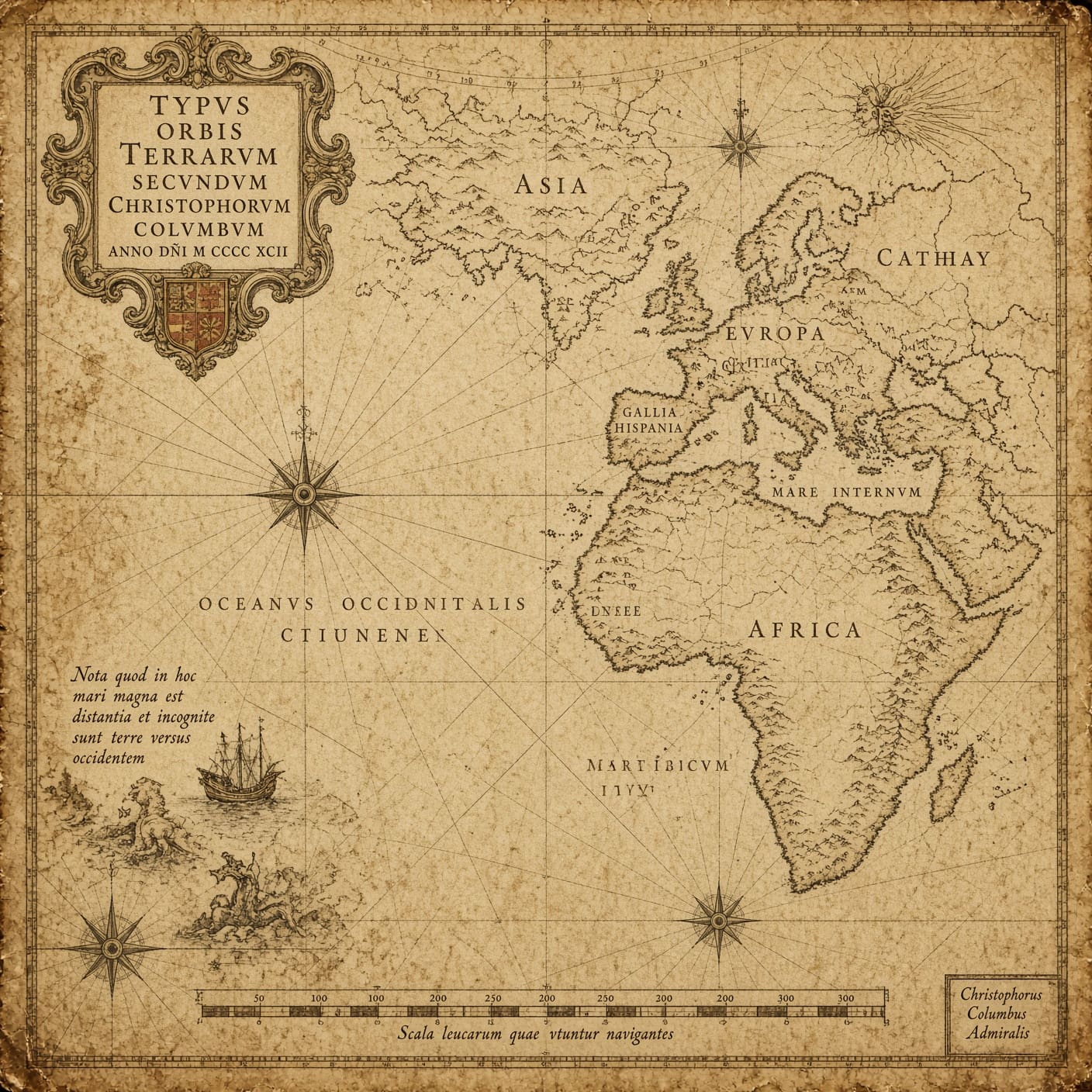
Who Was Christopher Columbus?
Christopher Columbus was a European navigator and explorer who became famous for his voyages across the Atlantic Ocean.
Born in Genoa, in present-day Italy, Columbus developed extensive experience at sea. By the late 1400s, European merchants were highly interested in reaching the valuable markets of Asia, where goods such as spices and luxury products could be obtained.
Columbus believed there might be another way to get there.
Instead of traveling east, he proposed sailing west across the Atlantic Ocean to reach Asia.
There was one very big problem: Columbus badly underestimated how far he would have to sail to reach Asia by traveling west.
What he did not anticipate was encountering the Caribbean islands along the way.
Why Did Christopher Columbus Sail West?
To understand the voyage of 1492, it helps to understand what Columbus was trying to accomplish.
European merchants wanted access to valuable goods from Asia, but existing trade routes could be long, expensive and difficult.
Columbus believed sailing west across the Atlantic could provide an alternative sea route.
He needed ships, sailors, supplies and—most importantly—money to attempt it.
After years of trying to find support for his plan, Columbus eventually received backing from King Ferdinand II and Queen Isabella I of Spain.
With their support, his expedition was finally ready.
The Niña, Pinta and Santa María Set Sail
On August 3, 1492, Columbus departed from Palos, Spain, with three ships:
- Niña
- Pinta
- Santa María
The Santa María served as Columbus’s flagship and was the largest of the three vessels.
But don’t picture enormous ships like the ones we have today.
These were relatively small wooden sailing vessels attempting to cross an enormous ocean without engines, GPS, satellites or modern weather forecasting.
After stopping in the Canary Islands, the expedition continued west across the Atlantic.
For the sailors aboard the ships, there was no way of knowing exactly when—or if—they would reach land.
What Happened on October 12, 1492?
After weeks at sea, everything changed.
Early on October 12, 1492, land was spotted.
Columbus and his expedition had reached an island in the Bahamas. Columbus called the island San Salvador, although the Indigenous people who lived there knew it as Guanahaní.
And this is where an important misconception about Columbus comes in.
Did Christopher Columbus Discover America?
You may have heard that “Christopher Columbus discovered America.”
The real story is more complicated.
Millions of Indigenous people were already living throughout the Western Hemisphere long before Columbus arrived. They had their own communities, governments, cultures, languages, economies and traditions.
Columbus also wasn’t the first European known to have reached North America. Norse explorers had traveled to North America centuries earlier.
What made Columbus’s voyage historically significant was what followed.
His 1492 expedition helped begin a period of sustained contact between Europe and the Americas that would dramatically alter world history.
Who Did Columbus Meet?
When Columbus arrived in the Caribbean, he encountered Indigenous peoples, including the Taíno.
The Taíno had established societies throughout parts of the Caribbean. They were skilled farmers and navigators and had their own political, religious and social systems.
Columbus initially believed he had reached islands near Asia.
He hadn’t.
His expedition was exploring the Caribbean.
Columbus continued traveling through the region, including areas around present-day Cuba and Hispaniola.
Did Columbus Know He Had Reached a New World?
One of the most interesting facts about Christopher Columbus is that he did not initially understand the true geography of what he had encountered.
His goal had been to reach Asia, and Columbus continued to believe that the lands he encountered were connected to Asia.
He returned to Spain in 1493 with news of his voyage.
And his first journey wouldn’t be his last.
How Many Voyages Did Christopher Columbus Make?
Christopher Columbus eventually made four voyages across the Atlantic between 1492 and 1504.
His expeditions explored parts of the Caribbean as well as areas along the coasts of Central and South America.
The voyages also encouraged further European exploration and colonization.
In the decades that followed, contact between Europe, Africa and the Americas increased dramatically.
That contact would transform the world—but it also had devastating consequences for many Indigenous communities.
How Did the 1492 Voyage Change History?
This is perhaps the most important question for kids to understand.
The significance of Columbus’s voyage goes far beyond three ships crossing an ocean.
After 1492, previously separated parts of the world became increasingly connected.
People, crops, animals, technologies, ideas and diseases began moving across the Atlantic on an unprecedented scale.
European exploration and settlement expanded throughout the Americas.
For European powers, these voyages opened opportunities for exploration, trade and territorial expansion.
For Indigenous peoples, the consequences were often catastrophic. European diseases caused enormous population losses, while conquest, forced labor, displacement and colonization transformed communities that had existed for generations.
Understanding 1492 therefore means learning both the remarkable story of exploration and the complicated consequences that followed it.
7 Christopher Columbus Facts for Kids
Here are a few facts kids can remember about Christopher Columbus and the voyage of 1492:
- Columbus was trying to reach Asia. He believed sailing west could provide a new route.
- His expedition left Spain on August 3, 1492.
- The three ships were the Niña, Pinta and Santa María.
- Land was sighted on October 12, 1492.
- The expedition first reached an island in the Bahamas, not the mainland of what is now the United States.
- Indigenous peoples had lived in the Americas for thousands of years before Columbus arrived.
- Columbus made four voyages across the Atlantic, with his final voyage beginning in 1502.
Why Should Kids Learn About Christopher Columbus Today?
History becomes much more interesting when children understand that events are connected.
The voyage of 1492 wasn’t an isolated adventure.
It became part of a much larger story.
Understanding Columbus and the age of exploration can help kids better understand later subjects they’ll encounter in American and world history—from European colonization and the thirteen colonies to the American Revolution and the eventual creation of the United States.
It also gives parents an opportunity to teach an important lesson about studying history itself:
History is rarely as simple as a single sentence in a textbook.
Kids should be encouraged to ask questions.
Why did people make the decisions they made?
What did they know at the time?
Who was affected?
What happened afterward?
And how did one event help shape the events that came next?
Those questions turn history from a collection of dates to memorize into a story kids can actually explore.
Help Your Child Explore the Discovery of America
There is much more to the story of the Americas than can fit into a single article.
The Kids Guide to the Discovery of America gives young readers an engaging way to explore the voyages, people and encounters associated with this important period in history.
Rather than simply memorizing names and dates, kids can discover what happened, why it happened and why these events still matter more than five centuries later.
It’s a great way for parents and grandparents to start conversations about exploration, courage, discovery and the complicated history that helped shape the world we know today.
Continue the journey with The Kids Guide to the Discovery of America and give your child the opportunity to explore the story of 1492 for themselves.

Recent Comments